Legal Document
GOVERNMENT OF ZAMBIA
STATUTORY INSTRUMENT NO. 41 OF 2003
The Standards Act
(Laws, Vol. 23, Cap. 416)
The Standards (Imports) (Quality Monitoring)
Regulations, 2003
IN EXERCISE of the powers contained in sections seven and thirtyseven of the Standards Act, the following Regulations are hereby made:
1. These Regulations may be cited as Standards (Imports) (Quality Monitoring) Regulations, 2003.
2. In these Regulations, unless the context otherwise requires—
“Authority” means the Zambia Revenue Authority established under the Zambia Revenue Authority Act;
“Bureau” means the Zambia Bureau of Standards;
“consignment” means a batch of products bearing a brand name from the same manufacturer and same country of origin;
“foreign or international standard” means a standard developed by a foreign standards body or the International Organisation for Standardisation (ISO), International Electrotechnical Commission (IEC), Codex Alimentarius Commission or other international body which may be recognised by the Bureau for purposes of the Bureau Product Certification Mark Scheme;
“import certificate of conformance” means a document issued by the Bureau upon being satisfied of the evaluation of a consignment;
“import commodity clearance means the clearance granted under regulation 7 in respect of imported commodities;
“import entry packing list” means a documented inventory of commodities in a consignment that is imported;
“ importer” means an individual, firm, or organisation involved in the direct procurement of commodities from outside the boundaries of the Republic of Zambia, for the purposes of selling, distributing or processing or any other use;
“import quality certificate” means a document issued annually by the Bureau to an importer of a commodity of the same brand from the same manufacturer and the same country of origin after four consecutive import shipments have been evaluated and found to conform to the relevant standards determined under the Act; and
“test certificate” means a document, issued by a laboratory, indicating the test results of a product.
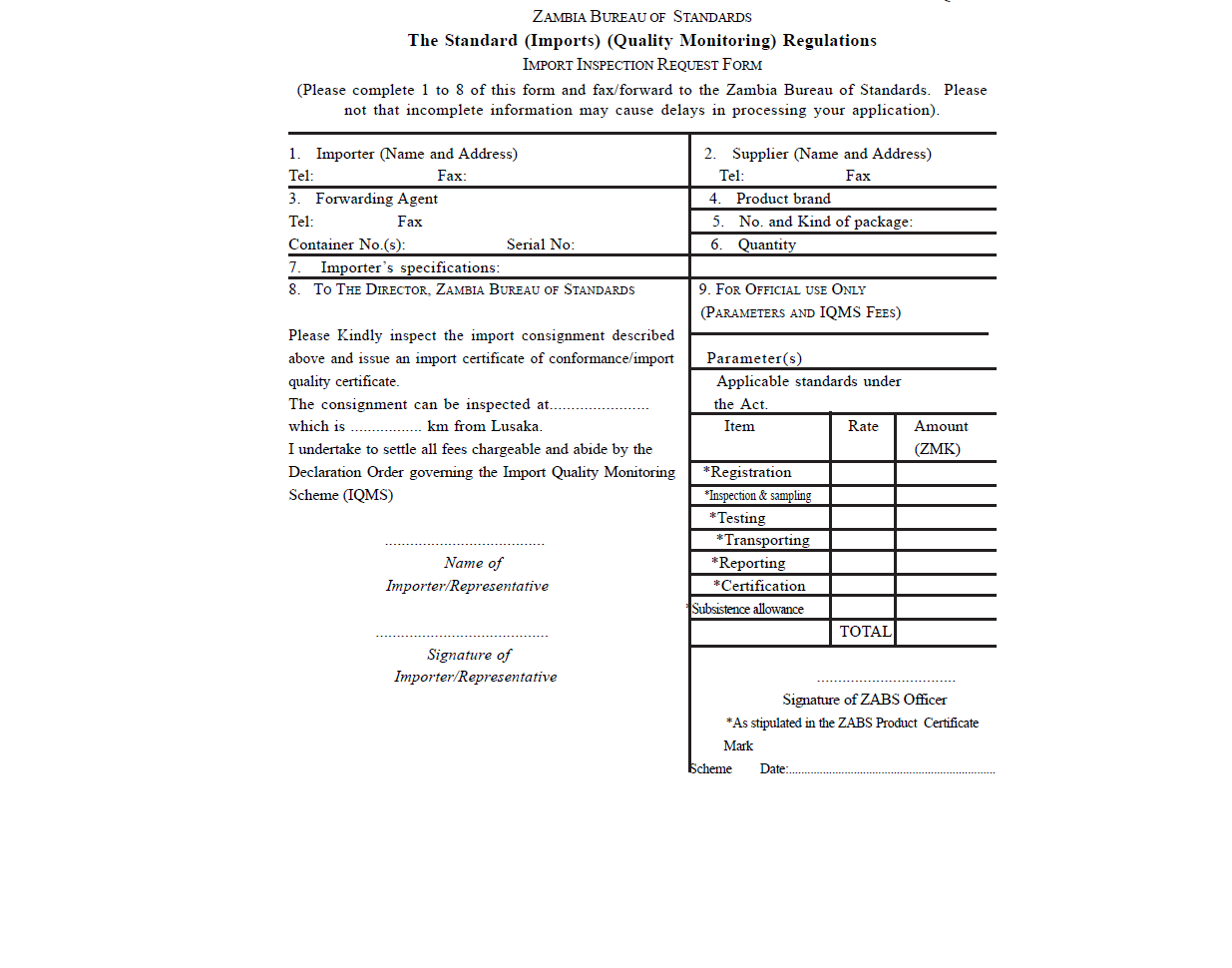
3. (1) An importer of a consignment containing a designated product listed in the First Schedule and to which standards declared under the Act apply shall apply to the Bureau for import commodity clearance before arrival of the consignment at a port of entry and prior to the Authority’s release of the consignment.
(2) An application for import commodity clearance shall be made by way of an Import Inspection Request Form, IQM 01, as set out in the Second Schedule.
(3) The Form shall be submitted to the Bureau triplicate together with an import entry packing list, the original copy of any test certificate, including the results if any, and any other shipping documents.
(4) The consignment referred to in subregulation (1) shall be subject to sampling and testing by an inspector.
4. (1) A consignment that is imported shall be evaluated by an inspector to determine its conformity to the applicable standards declared under the Act.
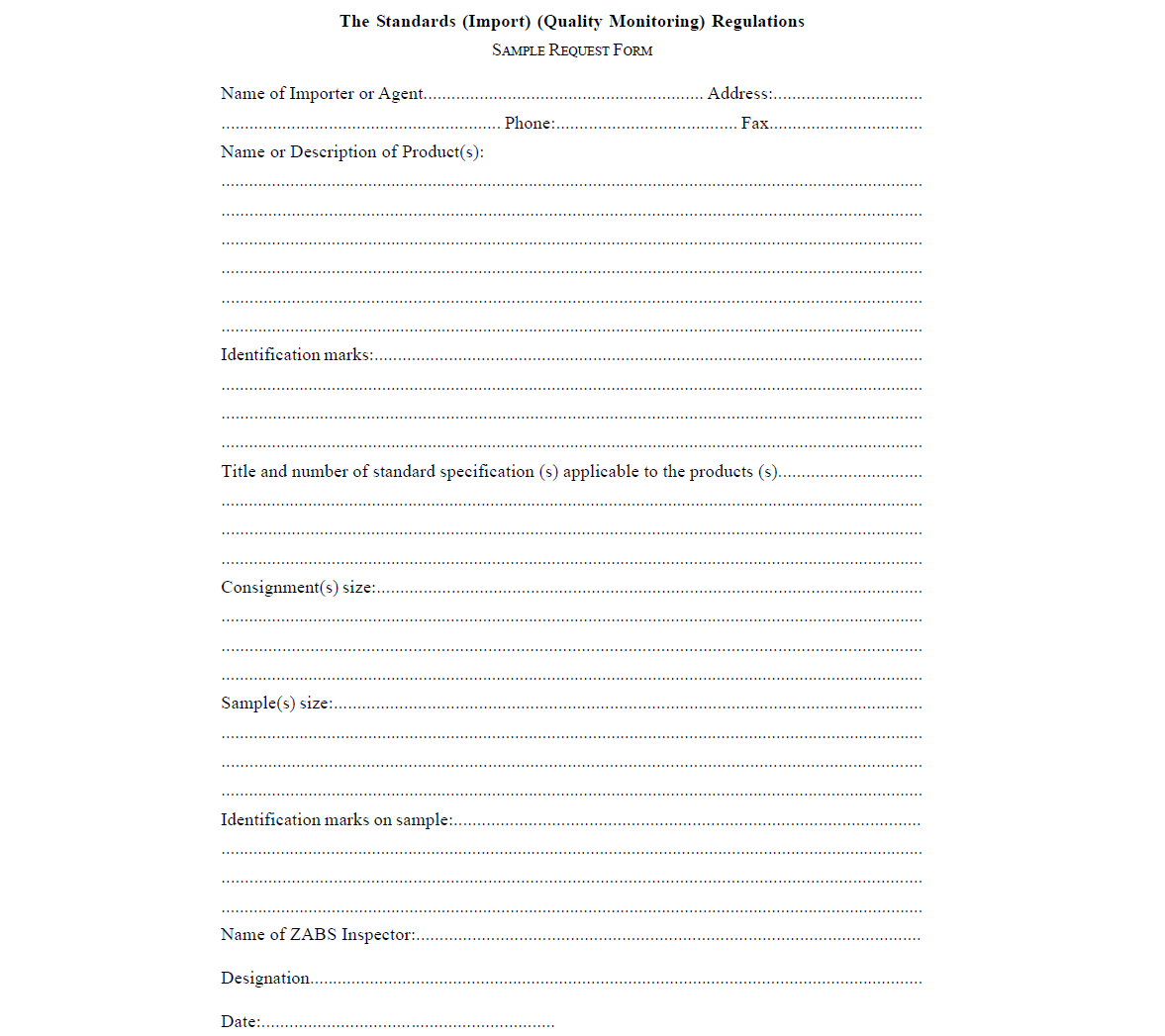
(2) An inspector, shall subject to sub-regulation (3) take samples for the purposes of laboratory analysis and shall complete, and issue to the person from whom a sample is taken, Sample Request Form, IQM 02, as set out in the Third Schedule.
(3) The sampling and testing of a consignment that is imported into Zambia may be waived where:
(a) the consignment is certified by a reputable competent testing organisation in the country of origin and duly recognised by the Bureau or relevant government authorities as conforming with the applicable standards under the Act; and
(b) the first four consecutive imported consignments, notwithstanding the certification that they conform to standards declared under the Act, are sampled and tested by the Bureau and the technical findings are found consistent with foreign test certificates issued after the commodities are found to conform to a foreign or international standards, and the applicable standards declared under the Act.
(4) Where random checks, which may include sampling and testing, reveal inconsistencies between the actual quality of imported products and the foreign test certificates issued stating that the products conform to the standards declared under the Act, a subsequent import of a consignment from the country concerned shall subject to sampling and testing by the Bureau, notwithstanding any certification from the country of origin, that the consignment conforms to the standards declared under the Act.
5. (1) Where the testing of any sample taken under sub regulations (2) of regulation 4 takes more than twenty days, an inspector may, upon the importer satisfying the Bureaus conditions for such release, conditionally release the consignment from the Authority’s custody.
(2) An inspector shall seal an imported consignment—
(a) prior to releasing the consignment under sub regulation (1); or
(b) where the consignment is to be transferred from the authority’s custody to the warehouse of the importer or consignee where an evaluation is to be performed.
(3) An importer or any other person shall not sell or transfer a consignment released under this regulation, whether in whole or as a part of its unless an importer commodity clearance is issued in respect of that consignment.
6. (1) The Director or any other person authorised by the Director so to do shall issue import commodity clearance on a consignment where satisfied that the imported consignment conforms to the standards declared under the Act.
(2) Certificates shall be issued for import commodity clearance in the following two categories:
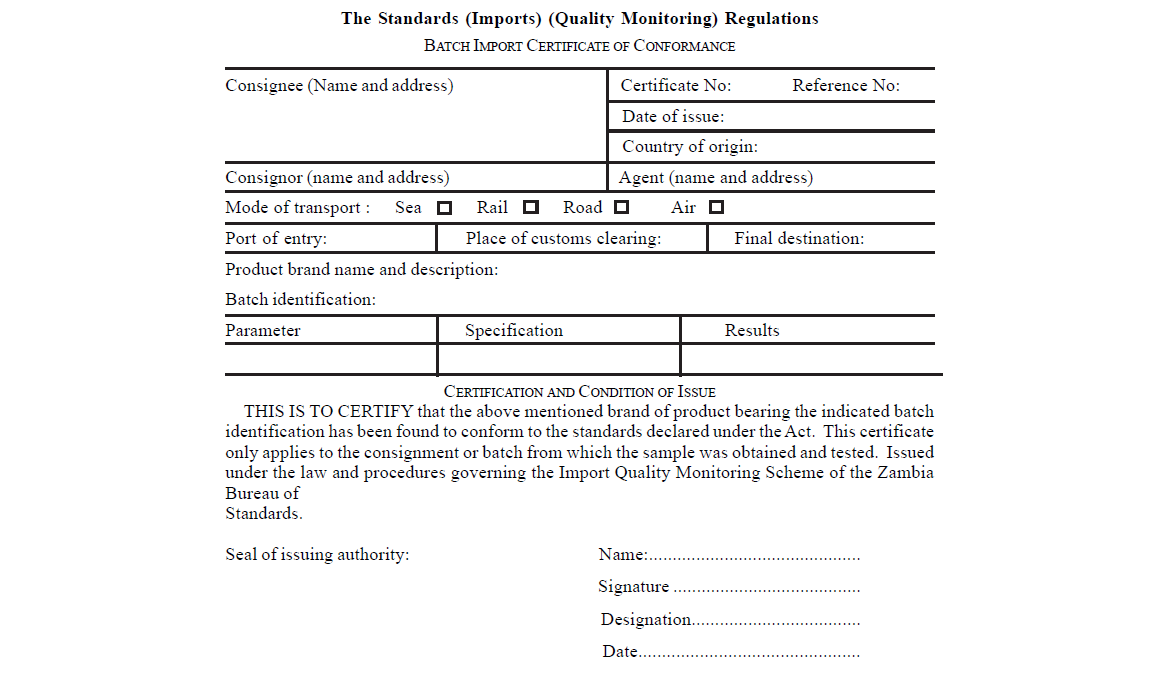
(a) a batch import certificate of conformance, as set out in the Fourth Schedule; or
(b) an import quality certificate, as set out in the Fifth Schedule.
(3) The validity of batch import certificate of conformance shall lapse upon the expiration of the shelf-life of the product to which it relates.
(4) A certificate may be re-issued in respect of a consignment subject to the consignment being re-evaluated.
7. (1) The Bureau shall withdraw an import quality certificate issued under paragraph (b) of sub regulation (2) of regulation 6 from an importer on the following grounds:
(a) if upon random sampling, on the open market of a product covered by the certificate and imported by the holder of a certificate the product is found to be non conforming to the standards declared under the Act;
(b) If the importer contravenes any provision of the Act; or
(c) If the importer fails to pay any fee as required by these Regulations:
Provided that prior to withdrawing the certificate the Bureau shall give the importer concerned notice of the intention to withdraw the certificate and shall afford the importer, in such period the Bureau shall specify in the notice, an opportunity to show cause why the certificate should not be withdrawn.
(2) The Bureau shall upon withdrawing an import quality certificate under sub regulation (1)—
(a) order the withdrawal of the imported product from the market;
(b) inform the public, by such means as it may determine, of the dangers of using or consuming the particular nonconforming product; and
(c) direct the importer to dispose of any recoverable nonconforming imported product.
(3) The expenses incurred by the Bureau in undertaking all the activities under sub-regulation (2) shall be borne by the importer of the non-conforming product.
(4) A person who sells an imported product shall ensure that the imported product is duly certified, by the Bureau, as conforming to the standards declared under the Act.
(5) A person who sells an imported product to which these Regulations apply shall, when required to do so by Bureau or an inspector disclose the name of the supplier of the product.
(6) If a person when required to do so by the Bureau or an inspector refuses to disclose the name of the supplier of an imported product referred to in regulation (5), the Bureau shall conduct an evaluation on the product or consignment in accordance with the procedures laid down in these Regulations and that person shall bear the costs incurred during such evaluation.
8. (1) The Bureau shall, wherever possible, return to the importer all samples drawn from a consignment for testing and laboratory analysis including those that have undergone destructive testing.
(2) The importer shall withdraw the samples from the Bureau within thirty days after receipt of notice to recover the samples.
(3) Where the importer fails to withdraw the samples after the specified date, the Bureau may dispose off the samples as it considers appropriate.
9. (1) An importer shall, prior to a consignment being cleared by the authority, pay to Bureau the following:
(a) expenses incurred by an inspector for the purpose of attending at the place and carrying out the inspection and returning from the inspection;
(b) testing fees charged by the Bureau or any laboratories designated by the Bureau for the testing of the imported products; and
(c) the fees charged for the issuance of a report and the batch import conformance certificate.
10. Every person who imports, displays, distributes or sells any product which is subject to standards declared under the act is deemed to warrant to the immediate purchaser that the product conforms to all requirements under the Act.
11. A person who contravenes these Regulations commits an offence and shall be subject to legal proceedings under the Act.
FIRST SCHEDULE
(Regulations 3)
DESIGNATED PRODUCTS SUBJECT TO IMPORT QUALITY MONITORING
Name of product
Beer
Biscuits
Cattle feeds
Compound fertilizers
Household and dishwashing liquid detergent
Lead-acid starter batteries
Poultry feeds
Refined edible vegetable oil
Rubber condoms (single use)
Toilet soap
Wheat flour
SECOND SCHEDULE
(Regulation 3)
Form I QM O1
THIRD SCHEDULE
(Regulation 4[2])
ZAMBIA BUREAU OF STANDARDS
Form IQM 02
FOURTH SCHEDULE
(Regulation 7(2)(a)
ZAMBIA BUREAU OF STANDARDS Form IQM 03
FIFTH SCHEDULE
(Paragraph 7(2) (b))
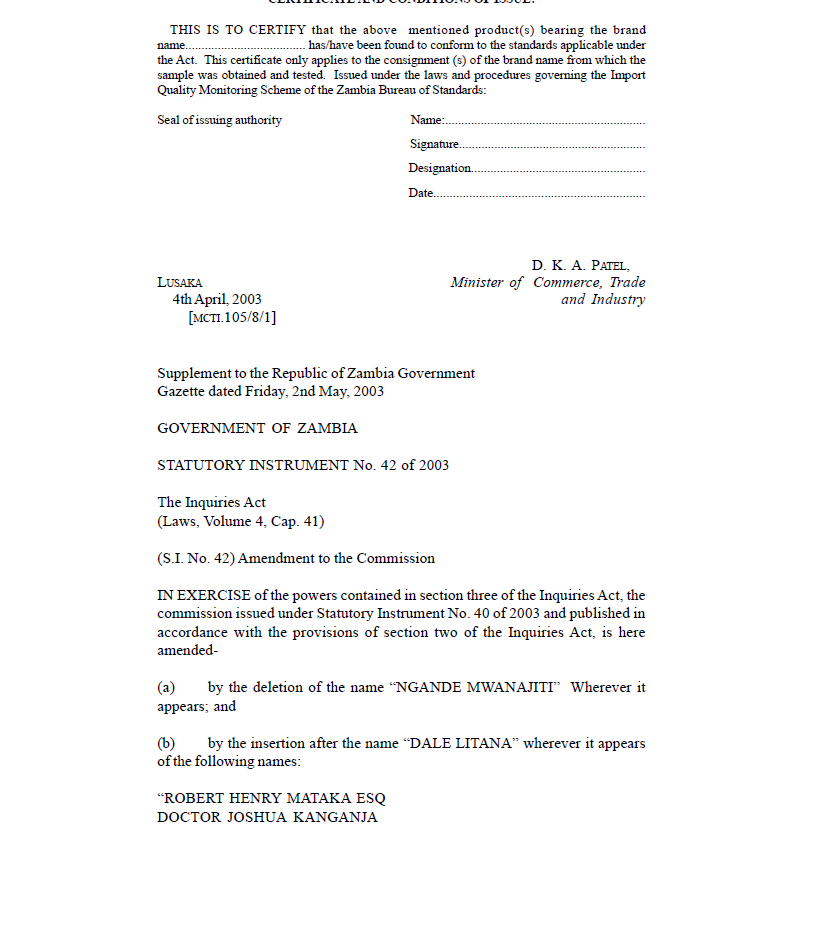
The Standards (Imports) (Quality Monitoring ) Regulations
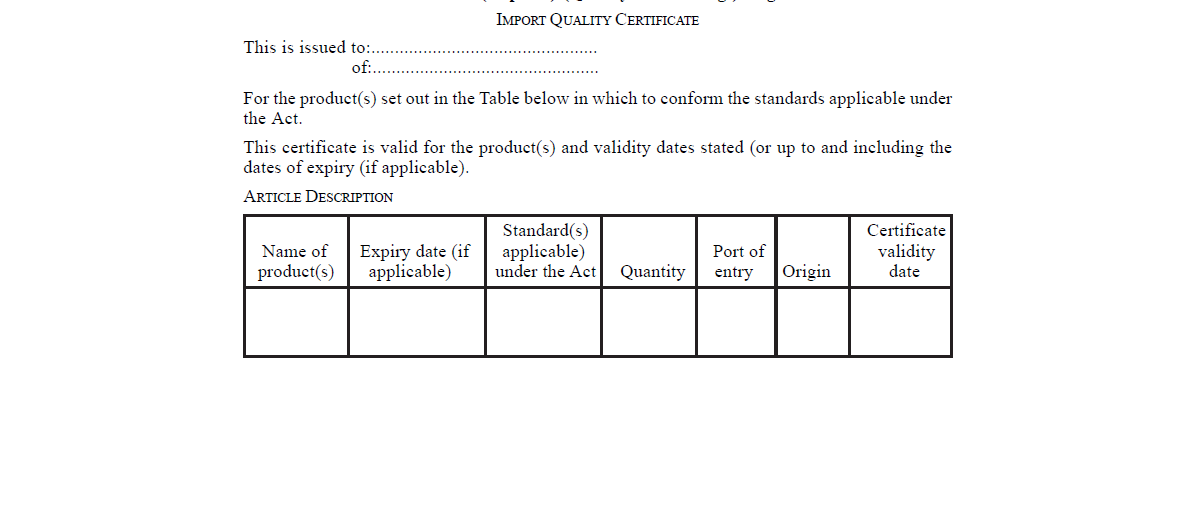
CERTIFICATE AND CONDITIONS OF ISSUE:
| Search Trade Information |
|
|
|
Feature Information |
 Commodities
 Measures
 Standards
 Legal Documents

 Forms
 Products
 SPS & TBT Enquiry Points
 Trade Agreements
 Guide to Export
 Guide to Import
 News
 Publications
 Announcements
 Articles
 Other useful links